
Published October 13, 2026
Selling a Probate or Trust Property in SLO County: A Step-by-Step Timeline

Selling a home through probate in San Luis Obispo County usually takes 9 to 18 months from filing to final distribution, and the house can often be sold well before the case closes. How fast you can sell depends on three things: whether the property is in a trust or in probate, what level of authority the court grants the executor, and how quickly the estate attorney, probate referee, and real estate team work together. Homes held in a properly funded living trust skip the court entirely and can often be listed within weeks.
If you are reading this because you recently lost someone, we are sorry. This guide is here so the next step feels clearer. It walks through each stage of the California probate timeline, what happens to the house at each point, and the tax and cost questions families in SLO County ask us most.
Last updated: October 12, 2026
Working with a Certified Probate & Trust Specialist
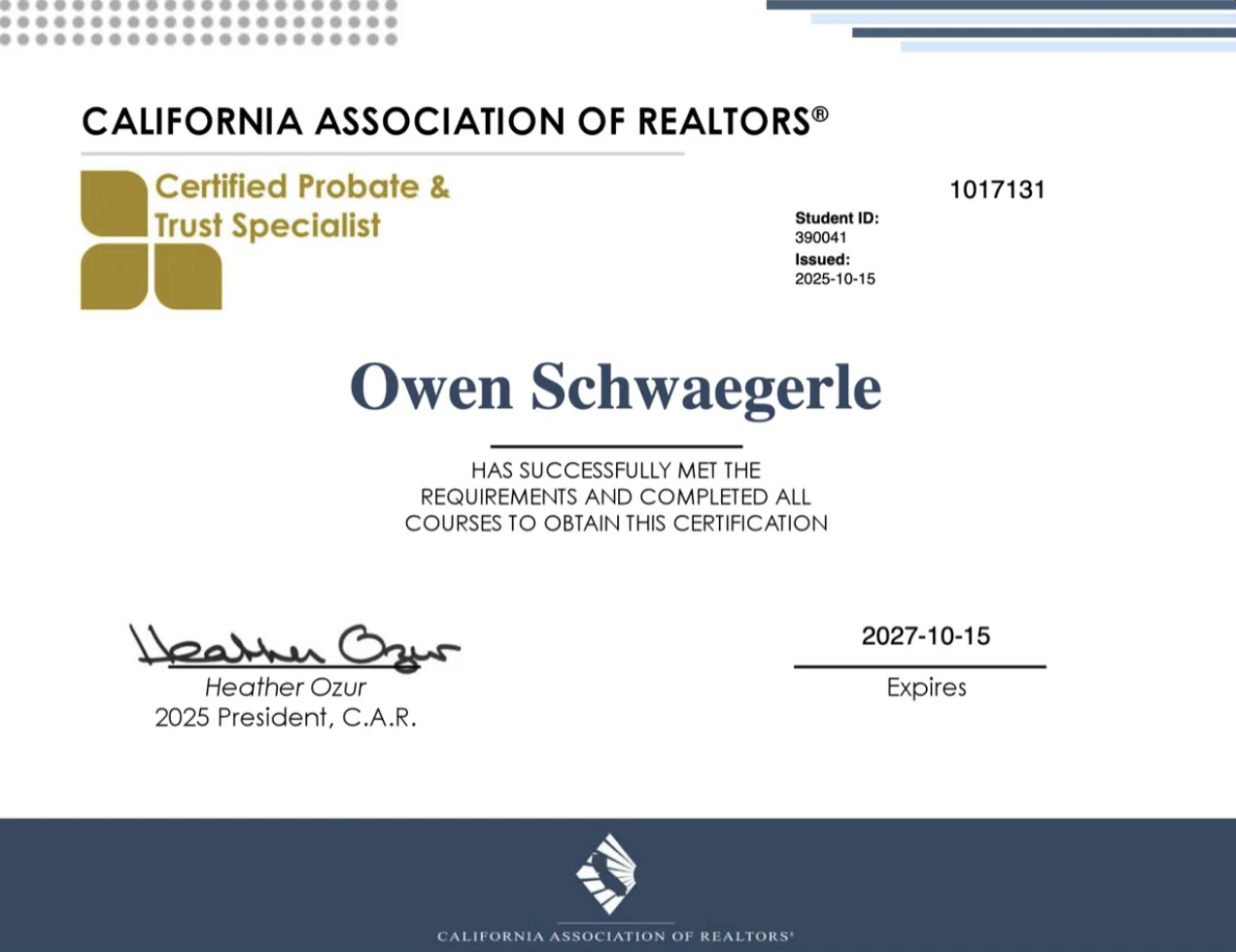
Owen Schwaegerle holds the Certified Probate & Trust Specialist certification from the California Association of REALTORS® (C.A.R.), earned in October 2025. The coursework covers the full California probate process from the real estate side: orders and letters, full versus limited authority sales, court confirmation and overbidding, and trust property transfers. We are not attorneys, and we do not replace your estate attorney. Our role is to handle the property side so your attorney can focus on the legal side.
Does the house have to go through probate?
Not always. A home only goes through full probate when it was titled in the deceased person's name alone, was not held in a trust, had no transfer-on-death deed or surviving joint owner, and is too valuable to use one of California's simplified procedures. Here is how the most common situations play out:
| How the home was held | What usually happens |
|---|---|
| Living trust (deeded to the trustee) | No probate. The successor trustee manages and sells the home under the trust's terms. |
| Joint tenancy or community property with right of survivorship | No probate. The surviving owner records an affidavit of death. |
| Primary residence worth $750,000 or less | May qualify for a Petition to Determine Succession, a shorter court process (AB 2016, effective April 1, 2025). |
| Will only, or no will, and the home is above the thresholds | Full probate through San Luis Obispo County Superior Court. |
Two numbers matter here. For deaths on or after April 1, 2025, personal property (bank accounts, vehicles, and similar assets) worth $208,850 or less can usually be collected with a small estate affidavit. Separately, AB 2016 lets heirs transfer a primary residence valued at $750,000 or less through a simplified petition. Because a large share of homes across SLO County are valued above that $750,000 line, full probate is still the path many local families end up on.
How long does probate take in San Luis Obispo County?
A straightforward probate in SLO County typically runs about 12 months, and contested or complicated estates can take two years or more. All probate matters in the county are filed and heard at the Superior Court's Civil and Family Law Branch on Monterey Street in San Luis Obispo. Here is the typical sequence:
| Approximate timing | What happens | What it means for the house |
|---|---|---|
| Start | The attorney files a Petition for Probate. Notice of the hearing is published in a local newspaper three times before the hearing. | Secure the home, change locks, and confirm insurance. Nobody can sell yet. |
| About 4 to 6 weeks | First court hearing. The judge appoints the executor or administrator. | Good time to start a property walkthrough and clean-out plan. |
| About 2 months | Letters are issued. The executor now has legal authority, posts any required bond, and opens an estate bank account with an estate EIN. | The home can be listed. With full authority, a sale can move like a normal escrow. |
| Within 90 days of letters | Notices go to the Franchise Tax Board, the Department of Health Care Services, and the Victim Compensation Board. | Handled by the attorney. No impact on listing. |
| Within 4 months of letters | Inventory and Appraisal is filed. A court-appointed probate referee values the real estate. The creditor claim period runs. | The referee's value sets the floor for limited-authority sales. Our market data can support the referee's review. |
| About 6 months | Tax filings: the decedent's final returns, any estate income tax returns, and Proposition 19 claims if a child is keeping the home. | Limited-authority sales typically reach their court confirmation hearing in this window. |
| About 9 to 12 months | Petition for Final Distribution and accounting, followed by a court hearing. | Sale proceeds are distributed to heirs per the court order. |
| End | Beneficiaries sign receipts, the executor files for discharge, and the case closes. | Done. |
The key takeaway from this timeline: you do not have to wait until month 12 to sell. Once letters are issued (usually around month two), the executor can list the home. Selling sooner often makes sense, because an empty house still costs money every month in property taxes, insurance, utilities, and upkeep, and those costs come out of what the heirs receive.
Can you sell a house during probate in California?
Yes. The executor can sell the home once letters are issued, and the process depends on whether the court granted full authority or limited authority under California's Independent Administration of Estates Act (IAEA). This single detail, written on the letters, decides whether the sale feels like a normal transaction or a court auction.
| Full IAEA authority | Limited IAEA authority | |
|---|---|---|
| Court approval needed? | No. A Notice of Proposed Action goes to heirs, who have 15 days to object. | Yes. The sale must be confirmed at a court hearing. |
| Minimum price | No statutory minimum, but heirs can object to a low price. | At least 90% of the probate referee's appraised value. |
| Overbidding | None. | Other buyers can outbid the accepted offer in the courtroom. |
| Contingencies | Standard inspection, appraisal, and loan contingencies are workable. | Buyers generally must be ready to close without contingencies once confirmed. |
| Typical timeline | Similar to a regular sale, roughly 30 to 45 days in escrow. | Often 60 to 90 days or more, depending on the court calendar. |
How court confirmation and overbidding work
With limited authority, the executor accepts an offer, the attorney files a Report of Sale and Petition for Order Confirming Sale, and notice goes to the buyer, heirs, and other interested parties. At the hearing, anyone can bid. Under Probate Code section 10311, the first overbid must be at least 10% of the first $10,000 of the accepted price plus 5% of the rest. On a $900,000 accepted offer, that means the opening overbid must be at least $945,500. Overbidders usually need a cashier's check for 10% of their bid in hand at the hearing.
For sellers, overbidding can push the price up. For the original buyer, it adds uncertainty, which is why limited-authority listings attract a narrower pool of buyers. Marketing these homes well means explaining the process clearly to buyers and their agents up front, so the accepted offer holds and the courtroom goes smoothly.
How is selling a trust property different from probate?
A trust sale skips the court entirely, so it is usually faster, more private, and closer to a normal sale. The successor trustee steps in, follows the trust's instructions, and can typically list the home as soon as they are ready.
- Notice to beneficiaries: Under Probate Code section 16061.7, the trustee must notify beneficiaries and heirs within 60 days of taking over. Recipients generally have 120 days to contest the trust.
- Proof of authority: Title companies usually ask for a death certificate, a certification of trust, and sometimes an affidavit of death of trustee recorded with the SLO County Clerk-Recorder.
- No referee floor or overbidding: The trustee still owes beneficiaries a duty to sell at a fair market price, which is why a documented pricing analysis protects the trustee.
- Watch for unfunded trusts: If the deed was never transferred into the trust, the house may still need probate or a court petition to move it in. Pull the current vesting before assuming the trust controls the home.
What taxes should heirs know about?
Most SLO County families will owe no estate tax, and many will owe little or no capital gains tax on an inherited home. Property tax is where the real decision sits.
Property tax: Proposition 19 replaced Props 58 and 193
Many older probate guides still reference Propositions 58 and 193. Those only apply to transfers before February 16, 2021. For deaths on or after that date, Proposition 19 controls. A child (or grandchild, in limited cases) can keep a parent's low property tax base only if the home was the parent's primary residence and becomes the child's primary residence within one year. The protected amount is the parent's taxable value plus $1,044,586 for transfers between February 16, 2025 and February 15, 2027. Rentals, second homes, and vacation properties no longer qualify at all and reassess to market value.
On the Central Coast this changes the math. A family that inherits a Pismo Beach rental or a Cambria second home will see its property taxes reset to current value, which often shifts the decision from "keep it" to "sell it" or "1031 exchange it."
Capital gains: the step-up in basis
Inherited property generally receives a new tax basis equal to its fair market value on the date of death (Internal Revenue Code section 1014). If the estate sells soon after, there is often little or no taxable gain. In California, community property held by a married couple can receive a step-up on both halves when the first spouse passes, which is a significant benefit worth confirming with your CPA.
Estate tax
California has no state estate or inheritance tax. The federal estate tax exemption is $15 million per person for 2026 under the One Big Beautiful Bill Act, so a Form 706 estate tax return only applies to the largest estates (or when a surviving spouse wants to elect portability).
What does probate cost in California?
California sets statutory fees for both the executor and the estate attorney, and each is calculated on the gross value of the probate estate, not the equity. Probate Code section 10810 sets the schedule:
| Portion of gross estate | Fee rate (each: attorney and executor) |
|---|---|
| First $100,000 | 4% |
| Next $100,000 | 3% |
| Next $800,000 | 2% |
| Next $9,000,000 | 1% |
| Next $15,000,000 | 0.5% |
For an estate with a gross value of $950,000, that works out to $22,000 for the attorney and $22,000 for the executor, or $44,000 combined, before court filing fees, publication, the referee's fee, and bond premiums. A $950,000 home with a $500,000 mortgage still calculates fees on the full $950,000. Family members serving as executor can choose to waive their fee. This is one of the clearest reasons many SLO County homeowners set up a living trust.
What does a probate and trust real estate specialist actually do?
A specialist handles the property so the executor or trustee does not have to manage it alone, often from out of town. Here is what that looks like with our team:
- Coordinate with your attorney on authority type, Notice of Proposed Action timing, and court confirmation filings.
- Protect the property while it sits: rekeying, utilities, vacant-home insurance (many standard policies restrict coverage once a home has been vacant for a set period), and regular checks.
- Manage clean-out and preparation with local vendors, and help decide which repairs are worth doing and which to skip.
- Price with documentation so a trustee can show beneficiaries the sale was fair, and so limited-authority offers clear the 90% referee threshold.
- Market for the process, including explaining overbidding and as-is terms to buyers so offers hold.
- Run the numbers on alternatives, such as keeping the home under Prop 19, renting it, or a 1031 exchange for heirs who want to stay invested.
What we see with our clients
Two recent families show how much the path matters, and how much a local team can take off an executor's plate.
A probate sale managed from 2,500 miles away
A client who had lost his wife was handling her probate on his own from Virginia. He had not seen the house in over 15 years, and it came with a tenant, years of deferred maintenance, and cockroach and flea infestations. He was overwhelmed.
We stepped in locally. We helped coordinate the tenant's move-out through the proper legal channels, arranged pest treatment and flea extermination, and got the home ready to market. Once it hit the market, it drew 16 offers in 7 days and sold for $90,000 over asking. Because the house was in probate, though, the estate is still working through the court process, and the family likely won't receive those proceeds until 6 to 8 months after closing.
Three trust properties sold in two months
Another family reached out after their father passed with his properties held in a living trust. With no court involved, we listed and sold all three properties within two months of his passing, and the beneficiaries received their proceeds on the day each sale closed.
Both families got strong results. The difference is how long they waited to receive the money, and that came down almost entirely to whether a trust was in place.
Frequently asked questions
How soon after a death can a house be sold in SLO County?
In probate, the executor can usually list the home about two months after filing, once the court issues letters. With full authority, escrow can close in roughly 30 to 45 days after that. With a funded living trust, the successor trustee can often list within a few weeks of the death.
Do all the heirs have to agree to sell the house?
Not necessarily. In probate, the executor holds the authority to sell, but heirs receive notice and can object, and an objection sends the sale to court. In a trust, the trustee follows the trust document. Disagreements are common, and getting everyone the same pricing information early helps prevent them.
Can I keep my parent's low property taxes if I inherit the house?
Only if the home was your parent's primary residence and you move in as your primary residence within one year, under Proposition 19. You must also file a claim with the SLO County Assessor. Rentals and second homes are reassessed to current market value.
Do we need to fix up an inherited house before selling?
Usually not. Probate and trust homes are commonly sold as-is, and the estate is not required to make repairs. Cleaning out the home and a few targeted improvements can still raise the net, so it is worth comparing the cost of each repair against the likely price difference before spending estate funds.
Do I need a real estate agent who specializes in probate?
It is not required, but probate sales have rules a typical sale does not, including the referee's 90% floor, court confirmation, overbidding, and Notice of Proposed Action timing. An agent trained in these steps can prevent delays that cost the estate money each month the home sits.
Not sure where to start?
We are happy to talk through your situation, whether you are an executor, a trustee, or a family member trying to understand the options. No pressure and no obligation. We can also connect you with local estate attorneys and CPAs.
Text or call 805-716-6653 to talk with our team.
Related reading
- How Proposition 19 affects inherited homes in SLO County
- What it actually costs to sell a house in SLO County
- Which repairs are worth doing before you sell
- Capital gains and 1031 exchange calculator
- Request a home value estimate
Sources
- Superior Court of California, County of San Luis Obispo: Probate
- California State Board of Equalization: Prop 19 exclusion adjustment (March 2025)
- Judicial Council of California: AB 2016 primary residence petition forms
- Sacramento County Public Law Library: small estate thresholds
- C.A.R.: Probate & Trust Specialist certification
- California Probate Code sections 8800, 9100, 9202, 10309, 10311, 10580 to 10592, 10810, 13100, 13151, and 16061.7
About the author
Owen Schwaegerle is a Broker and Co-Owner of The Schwaegerle Real Estate Team in San Luis Obispo County and a C.A.R. Certified Probate & Trust Specialist. He works with executors, trustees, and heirs, along with residential sellers, multifamily and 1031 exchange investors, and relocation buyers across the Central Coast. Owen is a Cal Poly SLO alum and hosts the Happy House Hacking Podcast. Meet the team or watch on YouTube.
This article is general information about California probate and trust real estate and is not legal or tax advice. Probate and trust administration involve legal requirements that depend on your specific facts. Please consult a California estate attorney and a CPA before making decisions. Figures and thresholds are current as of the date above and are adjusted periodically.
The Schwaegerle Real Estate Team | Owen Schwaegerle, DRE #02040597 | Camille Schwaegerle, DRE #02107467